Though I’m looking forward to moving ahead with Tragedy and Comedy, I’ve stepped back a bit to improve the Greek epic offerings here.
- Nonnus’ Dionysiaca and Quintus Smyrnaeus are both now scanned and posted
- both texts are the Perseus versions (older Loebs), but I’ve proofread them with some care and made a lot of corrections. A lot of corrections. The Nonnus fixes have been submitted to Perseus; I’ll gather the Quintus fixes and submit them when Perseus processes Nonnus. Gratitude to the sedes project for sharing their data and helping me to catch some errors.
- My texts of the Iliad and Odyssey have received a lot of work:
- both now align with the versions at Perseus. This means that they should be easier to connect to the Homer treebanks (something I’ll be working on myself soon).
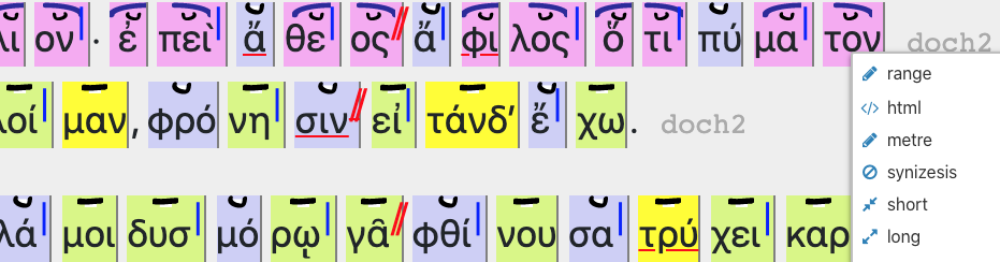
- I’ve spent a lot of time improving syllable division. This was poor to start with in these texts (they were the first I worked on, and it showed). But ‘correct’ syllabification does not necessarily produce elegant output, and I’ve worked to keep a balance between a version that follows standard rules, and one that (above all) keeps prefixes clearly separated (sometimes suffixes too). If, for instance, you’ve ever been slowed in reading by having to figure out if a word is prefixed with ἐπί, or if the root starts with π and has the temporal augment, I try to make that difference clear. There is more work to do here, but I think it’s important. It’s fairly trivial to convert back to linguistically valid syllabification if that matters in your work, but going in the other direction is decidedly non-trivial.
- data-speaker attributes have been added to lines. The Iliad previously had the speaker in the line class, the Odyssey (like the Perseus xml) had nothing. Gratitude to the dices project for the data that made this a quick fix. My web version (like the Perseus xml) also lacked quote marks for speeches: these have now been added.
- long syllables have been tagged as bil (brevis in longo), lbp (long by position) and lbn (long by nature). Toggles have been added to the interface to allow showing/hiding bill also hiatus (non-correption of long vowel, non-elision of short vowel) and diastole (lengthening of short syllable for no evident reason – for now I make no effort to distinguish between the variants of lengthening, such as digamma residue, analogical lengthening, caesura lengthening etc., though this would be a useful addition).
- syllables lengthened before a liquid or δϝ are tagged as such (preliquid, pre-dw), and identified with single underline. A complication here is that, data-wise, these syllables should have the same quantity attributes as ones where the chosen edition prints double characters for the liquid or the delta (e.g. φιλομμειδὴς in Allen’s, and so our, Iliad, e.g. 5.375; but contrast 3.424).
- correption is also tagged in the syllable class, but it is so common that showing it in the interface would be cluttersome.
- syllables not lengthened by mute + liquid are tagged with ‘mcl’ in their class (Attic correption is the exception rather than the rule in epic).
- lbn (long by nature) syllables with alpha, iota or upsilon (and no circumflex) have a macronized version in a data-mac=”τλᾱς” (etc.) attribute. A toggle in the interface allows these to be hidden or shown.
- I don’t recommend using macronized Greek text for data work. If you do, be aware that characters with accent and macron (or breathing and macron, etc.) are strings with length of 2 or even 3 characters. Folks from the betacode days won’t be phased by this, but for most of us it adds an unneeded complication. Note too that they display well with the default font used by my site, but will not behave well with all fonts. James Tauber has a series of posts about this.
- A number of smaller fixes have happened which I won’t list here, except to say that these texts now only use the high dot character (Greek Ano Teleia) for the Greek semicolon, rather than the middle dot which is commonly substituted for it.
Plans for the next few months:
- produce json versions of each text following the multi-part syllable structure I’ve been working on for tragedy
- when this is done, establish a repo on Github for the site (finally!)
- document provenance for each text
- generate alternative presentation versions of each text (plain text, pdf – what else?). I already have the code to automate this, including LaTeX versions for pdf (see my Vergil offerings).
- refine methods for integration of metrical data with treebank data.
- apply the above improvements (lbn, bil, macrons) to all my Greek texts, starting with hexameter epic. Also add bil, diastole, hiatus to all the Latin texts (they are there in some of them)
- get back to making progress on Tragedy and Comedy, including posting some work that is already 99% finished but never got posted here (Frogs, Agamemnon, Antigone, Oedipus Rex – I think that’s it).
Plans for the next year:
- I’m setting myself a deadline of June 30, 2027 to publish the data as version 1.0 with DOI etc. That will probably be a github version.
- I had considered hosting at the University of Oregon (my employer), but there is a significant chance the Classics department here will be closed within the next two years (and along with it the only option for Oregon students to learn ancient Greek at a public university).
